Last Updated on August 25, 2026 by ellen
Some kids come home from school and need to run. Others come home wired, bounce off three walls, and then melt down at 5pm because nobody, including them, noticed they were exhausted.
Posts may be sponsored. This post contains affiliate links, which means I will make a commission at no extra cost to you should you click through and make a purchase. As an Amazon Associate I earn from qualifying purchases.
Sound familiar? If it does, the fix is not another quiet activity you have to supervise. It is a small set of things your child can start alone, stop halfway through, and come back to tomorrow. Below are the ones that hold up in real houses, on real evenings, with more than one child in the room.
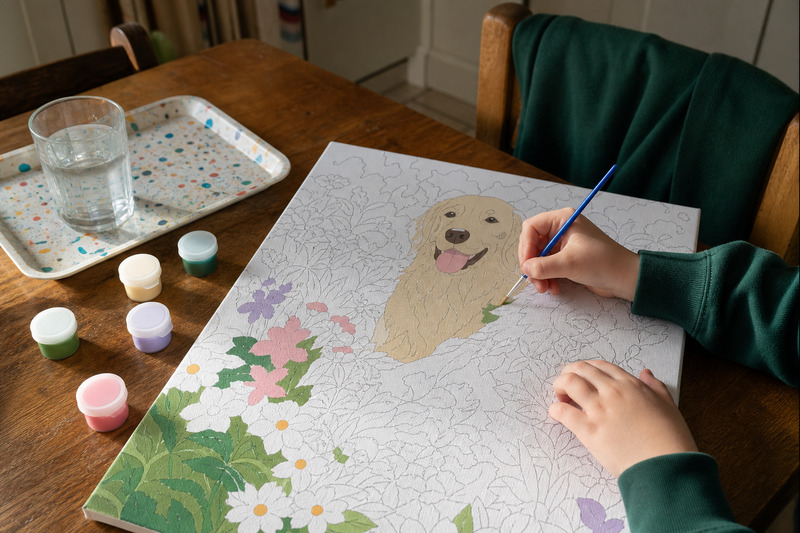
Table of Contents
What actually makes an activity calming
A calm activity is one a child can start alone, stop halfway, and come back to tomorrow, which is not the same thing as a slow one. Three things tend to be true of the ones that work:
- It has a clear next step, so there is no blank page to stare at
- It can be abandoned mid-way without ruining it
- It rewards attention rather than speed
Which of the three matters most? That last one. Anything with a timer or a score turns into a competition within four minutes, especially with siblings. Anything that just continues, section by section or row by row, tends to settle the room instead.
| Activity | Ages it suits | Can they do it alone? |
|—|—|—|
| Paint by numbers | 7 and up | Yes, after the first sitting |
| Sticker mosaics | 4 to 8 | Yes |
| Kinetic sand or playdough | 3 to 7 | Yes, with a tray |
| Jigsaw on a board | 5 and up | Mostly |
| Audiobook plus drawing | 4 and up | Yes |
| Lego with a picture, not free build | 6 and up | Yes |
Paint by numbers, one section at a time
A numbered canvas is printed with small outlined sections, each with a number matching a pot of paint, so the picture appears as your child fills them in. There is nothing to design and nothing to get wrong, which is exactly why it works for a child who gives up the second something looks hard. Does the canvas itself matter? More than you would guess. Davincified sections each canvas with an algorithm tuned to keep the shapes big enough for small hands, so a child’s version does not dissolve into fiddly slivers.
The version that gets the most use in our house is a custom paint by numbers kit from your own photo. Davincified prints the canvas from the picture you upload, so instead of a generic sunset your child is slowly painting the dog, or last summer at the lake, or their grandmother’s kitchen. That difference matters for the ones who lose interest fast: they are finishing something they recognise. You also see a preview of exactly how the photo converts before you order, which avoids the classic our-dog-came-out-strange problem.
Two practical notes. Cover the table, because water cups get knocked over roughly every third session. And let them stop when they stop. A canvas left out on a tray gets picked up again after dinner; one packed away after twenty minutes usually does not.
Sticker mosaics for the younger ones
A sticker mosaic is a numbered board with sheets of small numbered foam stickers, so the picture builds up the same way a numbered canvas does, with no water and no drying time. For under-eights it does the same job as painting and makes a fraction of the mess.
They are also genuinely portable, which makes them the thing to keep in the car for the long wait outside a sibling’s swimming lesson.
RELATED: After School Activities for Kids Who Are Too Tired to Play
Something to do with their hands while they listen
Plenty of kids cannot sit still to listen, and are then told off for not listening. Give them something for their hands and the listening improves.
An audiobook with a stack of paper and pencils works. So does playdough, or a bin of Lego with a build card rather than free build, which removes the decision-making that makes free play tiring at the end of a long day.
A jigsaw that lives on a board
The reason jigsaws get abandoned is that they take over the dining table. Put one on a cheap foam board or a large tray and it can slide under the sofa half-finished, which is the difference between a puzzle that gets done and one that gets tipped back in the box on day two.
How small? Our rule is half the piece count you think they can manage. Start smaller than you think. A 300-piece puzzle finished in two evenings does more for a child’s sense of themselves than a 1,000-piece one that never gets past the edges.
When to stop offering and just start doing it
Here is the part nobody tells you: kids very rarely choose the calm thing when asked. Ask a tired seven-year-old whether they want to paint or watch something, and you know the answer.
So do not ask. Set it out on the table before they come in, sit down, and start doing it yourself. Most children will drift over within a few minutes, largely because you are doing something and not looking at them. If screen time is the wider battle in your house, the American Academy of Pediatrics keeps its guidance for families on children and media in one place, and their family media plan is a calmer starting point than an argument at 5pm.
If you want to try it tonight, this is the whole setup:
1. Clear one end of the table and cover it with an old towel
2. Put the activity out before pickup, not after
3. Sit down and start it yourself, and say nothing at all about it
A basket by the door beats a cupboard upstairs
Every one of these fails the same way. The kit is in the loft, the pencils are in someone’s room, and the calm activity loses to the tablet because the tablet is right there.
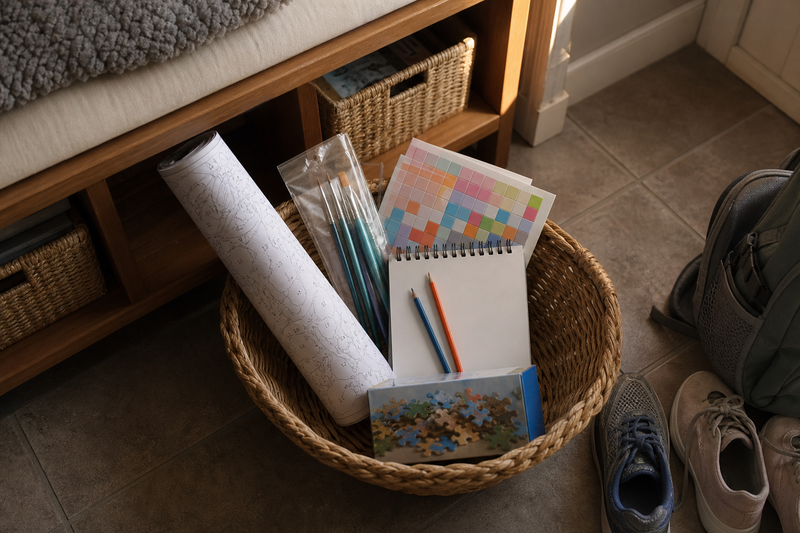
One basket, kept where the after-school collapse actually happens, holding the canvas and brushes, a sticker mosaic, a pad of paper and a couple of pencils. That is the whole system, and it is the only part that really matters.
A few questions parents ask
At what age can a child do a numbered canvas alone? Around seven for most, earlier with a bigger design and larger sections; younger than that, expect to sit with them for the first session. If you are buying for a younger child, it is worth scanning the ready-made paint by numbers kits for a bold, simple subject rather than a busy landscape. Do these actually calm a hyperactive child down? They give a wound-up child somewhere to put their attention, which is usually what is needed. They are not a substitute for a doctor’s advice if you are worried about something more. How do you stop it being another thing you have to tidy? Choose activities that can live on a tray. Anything that has to be fully packed away between sessions gets done once.
None of this makes the 5pm hour disappear. But a table with something half-finished on it changes what that hour is for, and most evenings that is enough.

Welcome to In Our Spare Time, your go-to source for family-friendly fun. Discover honest reviews, entertaining articles, and fresh ideas for making the most of your free time with younger kids. From games, movies, and books to family activities and seasonal adventures, we help parents find simple ways to create memorable moments together.