Last Updated on November 17, 2026 by ellen
Watching your child play with blocks or run around the yard may seem like simple amusement. But beneath the surface, there’s more going on. Your child’s brain develops with each play session.
Posts may be sponsored. This post contains affiliate links, which means I will make a commission at no extra cost to you should you click through and make a purchase. As an Amazon Associate I earn from qualifying purchases.
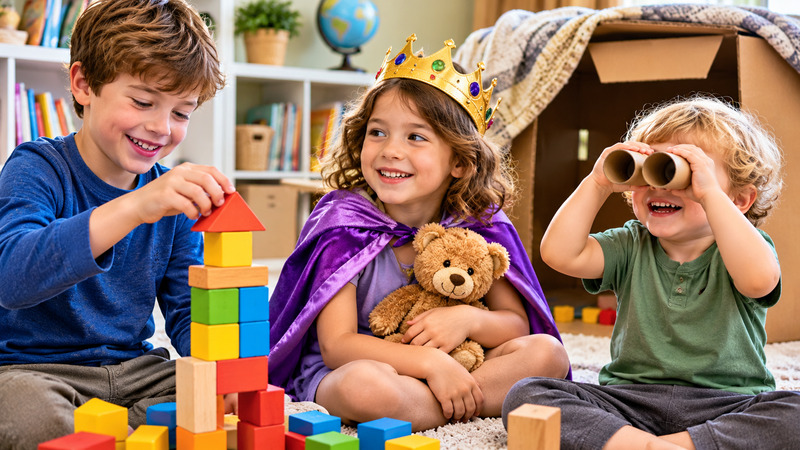
Table of Contents
Why Play Builds Better Brains
When your child pretends to roar like a dinosaur or haggle over the last cookie during an imaginary tea party, neurons are firing and forming connections. Repetition helps strengthen neural pathways associated with attention and memory. When a toddler builds the same block tower 40 times, she’s not hitting an imagination wall. She’s practicing skills and strengthening brain connections that will help her focus down the road.
Creative play engages areas of the brain associated with flexible thinking and executive function. When your son imagines an outlandish scenario for his toy cars, he is building skills he may use one day for troubleshooting. No flashcards needed. No screen required. Just a cardboard box and some imagination.
The Different Flavors Of Play
Variety is important in play. Imaginative play with props and fabricated storylines can support language development. Songs, rhymes, and storytelling help expand vocabulary. Building with blocks or playing counting games supports early math development. Sorting blocks or objects by color or size provides opportunities to recognize patterns without worksheets. Jigsaw puzzles and open-ended toys challenge children to use problem-solving skills. A trip on a living room scavenger hunt can help a developing brain more than you might expect.
Playing with other children is another ballgame altogether. Learning to take turns and reading a peer’s facial cues during play can develop perspective-taking and early reasoning skills. Dialogue during play also provides opportunities to practice language and communication skills.
A simple set of wooden building blocks can encourage hours of open-ended play as children practice stacking, sorting, counting, and creating their own designs.
Finding The Right Balance
“How much structured play should I give my children?” parents may inquire. Well, unstructured exploration and play are important parts of a child’s day, but there is no universal percentage of time that should be devoted to them. Outdoor physical play is also beneficial. Children should have opportunities to run around, climb on things, and get dirty. Adult-led experiences are good, too, but should be balanced with child-directed play. Time spent reading books, playing with crayons, or engaging in quiet activities also provides opportunities for learning.
What This Looks Like At Different Ages
Play for children ages Pre-K-2 isn’t just enrichment or downtime from learning. Play IS learning. This period of childhood is when the brain is developing connections that support language, math, and social interaction. Instructional lessons are important, but they should be balanced with free exploration and open-ended play. When a child spends her day building forts and creating games, she’s doing what her brain needs for healthy development.
Bringing More Play Into Everyday Life
You don’t need a fancy playroom full of equipment to encourage this type of growth. No visits to pricey mall toy stores are necessary. Ideas include:
- Make cleaning up toys a timed event.
- Put a box of safe household items on the floor and let your child create what they want.
- Build a makeshift obstacle course out of stuffed animals or couch cushions and pillows.
Having a story swap each night before bed is also a great idea. Everyone takes turns adding one sentence to a fictional story. This helps your child practice sequencing, vocabulary, and imagination in one activity. And you both might find yourselves laughing and enjoying the unexpected outcomes!
For more inexpensive activities that encourage creativity, try these fun ways to play with cardboard, including imaginative building projects and pretend-play ideas.
The Bottom Line
Play isn’t just an activity that happens after “real” learning takes place. Play is a healthy way to help brain development occur. It’s an important form of active learning. Every block tower constructed, pretend scenario created, and game of tag played can help build your child’s brain and support development over time. When you allow your children to play, you are giving their brains opportunities to develop skills that can help them throughout their lives.
AUTHOR BIO: Tammy Mays is the Chief Operating Officer of The Brunswick School, an independent early childhood and elementary institution dedicated to inspiring and empowering young learners through a nurturing, high-performing academic environment. She has extensive experience in school operations and leadership and focuses on aligning day-to-day operations with strategic goals — overseeing campus infrastructure, HR, finance, compliance, and facilities. Tammy plays a key role in scaling systems to support enrollment growth, enhancing the family experience, and fostering an inclusive, mission-driven culture grounded in continuous improvement and operational integrity.

Welcome to In Our Spare Time, your go-to source for family-friendly fun. Discover honest reviews, entertaining articles, and fresh ideas for making the most of your free time with younger kids. From games, movies, and books to family activities and seasonal adventures, we help parents find simple ways to create memorable moments together.